Research
Showing all 6 research projects
Multimodal Analysis in Digital Pathology
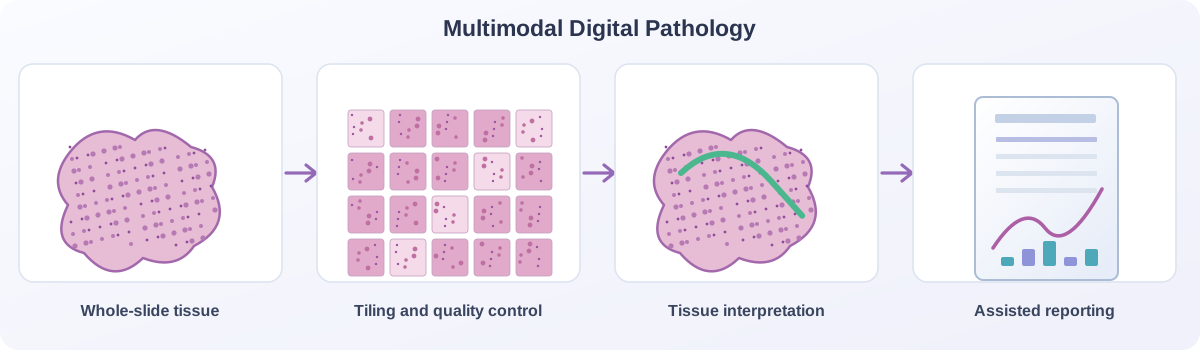
Developing end-to-end whole-slide image (WSI) and multimodal histopathology pipelines, with an emphasis on scalable image processing, trustworthy data quality, pathology foundation models, and reproducible downstream analysis.
Research objectives & contributions
- Build workflows for WSI and tile-level tissue classification, tumor segmentation, and image-text analysis.
- Design artifact filtering, tile extraction, and image-quality checks for consistent model inputs.
- Use QuPath for tumor-region annotations and reference-label quality assurance.
- Curate large-scale, tile-level histopathology datasets for benchmarking and reproducible evaluation.
- Train and integrate image and multimodal foundation models for biomedical analysis and reporting.
- In related clinical laboratory AI work, develop automated analysis of serum protein electrophoresis and immunofixation electrophoresis, including monoclonal peak quantification and abnormal-band detection.
Abnormal Image Detection and Localization of Fabric Products
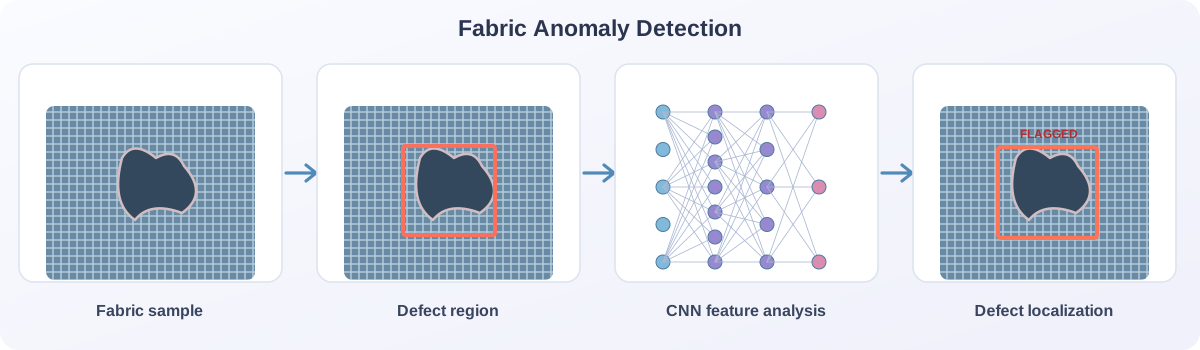
Developed image-analysis methods to distinguish defective from non-defective fabric products and localize irregularities for automated quality-control inspection.
Research objectives & contributions
- Apply spectral clustering to separate defect and non-defect image groups.
- Use transfer learning with deep convolutional neural networks for defect detection and localization.
- Develop repeatable vision-based workflows for industrial anomaly inspection.
Gesture Recognition and Interactive Systems
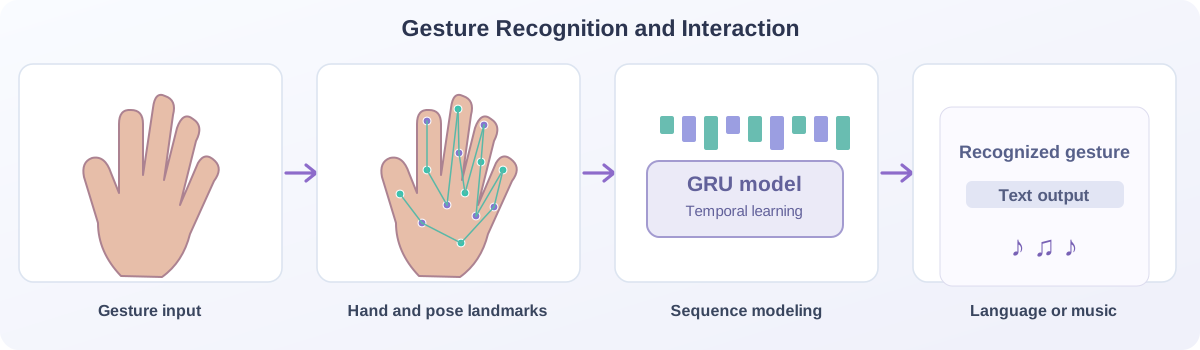
Investigated real-time gesture understanding for Indian Sign Language and interactive applications through visual landmark tracking and temporal sequence learning.
Research objectives & contributions
- Curate multi-label datasets for sign-language recognition and gesture-driven music interaction.
- Extract timestamped face, hand, and pose landmark sequences using MediaPipe.
- Train GRU-based models to learn the temporal dynamics of human gestures.
- Map recognized gestures into language or musical representations for interactive output.
Lightweight Model for Disabled Parking Sign Detection
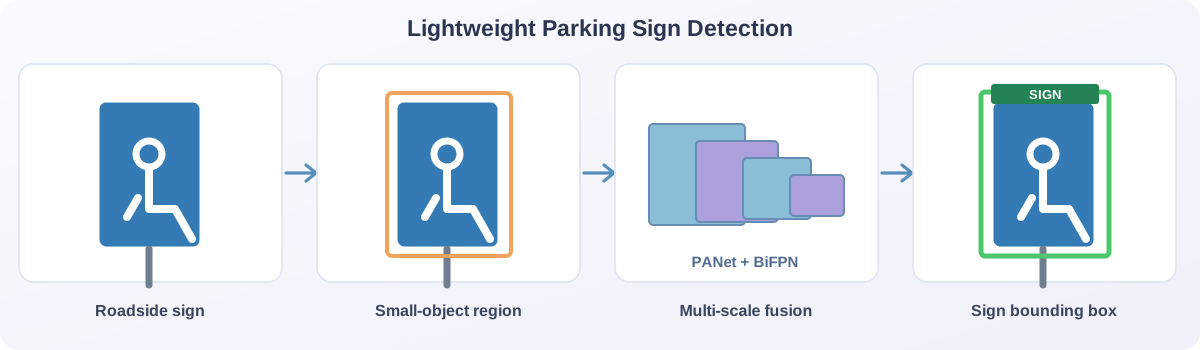
Developed a lightweight, feature-fusion-based object detector to improve small disabled-parking-sign localization while controlling model size and computational cost.
Research objectives & contributions
- Enhance YOLOv5 for small-object detection through PANet and weighted BiFPN feature fusion.
- Explore architectural simplifications to reduce parameters and floating-point operations.
- Evaluate on 1,025 original sign images expanded through augmentation to approximately 15,000 samples.
Korean Handwritten Text Recognition
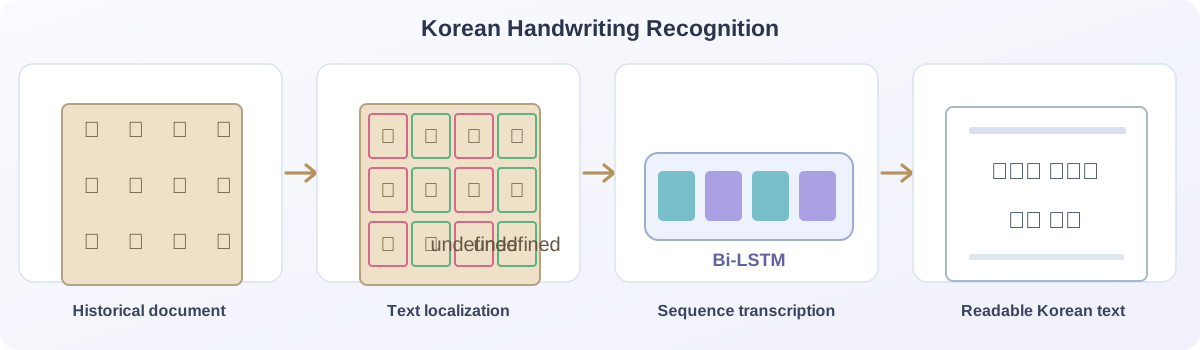
Built a document understanding pipeline for locating historical Korean handwritten text and converting detected regions into machine-readable transcription.
Research objectives & contributions
- Prepare handwritten text annotations and bounding-box labels.
- Detect text regions using CNN-based localization methods.
- Transcribe handwritten sequences using bidirectional LSTM models.
Real-Time Emotion Recognition System
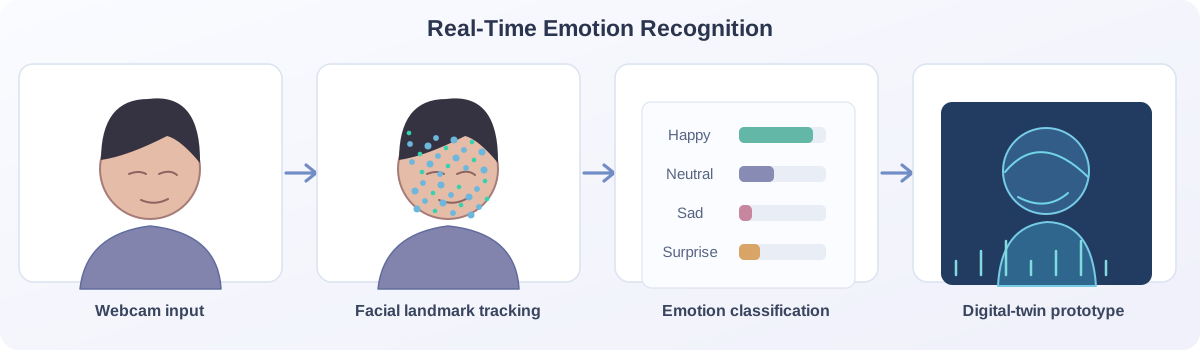
Investigated webcam-based expression analysis and an emotion-aware decision-support prototype using multi-region landmark extraction and machine-learning models.
Research objectives & contributions
- Curate a custom webcam dataset with diverse facial expressions and recording conditions.
- Extract face, hand, and body landmarks with MediaPipe.
- Train and benchmark multiple machine-learning approaches for real-time emotion recognition.
- Explore integration with a digital-twin prototype; this research is not presented as a clinically validated diagnostic system.
Research projects summarize the broader work and responsibilities. Manuscript titles, acceptance status, and publication links are presented separately under Publications.