Gesture Recognition and Indian Sign Language
Landmark-based gesture understanding with MediaPipe and GRU sequence models
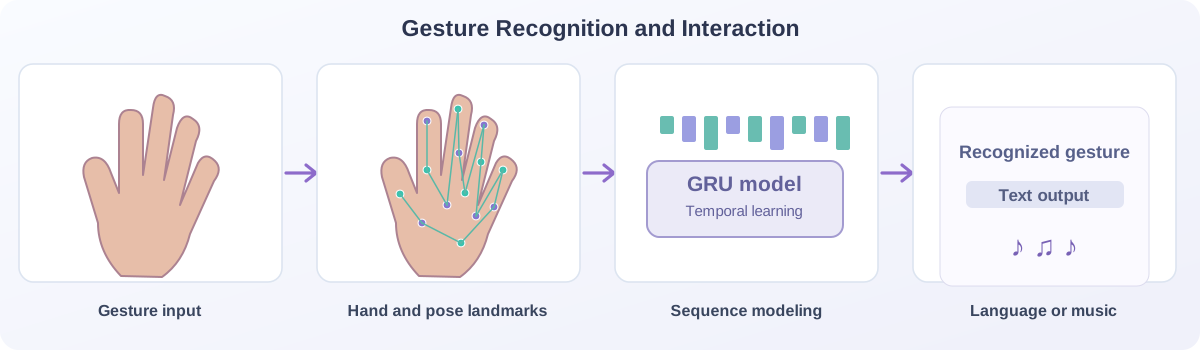
This project investigated temporal gesture understanding for Indian Sign Language (ISL) and gesture-driven interaction. The focus was on converting tracked face, hand, and pose landmarks into time-aligned sequences that can be modeled for real-time recognition.
Research period: February 2022 to May 2023
Funder: School of Computer Science and Engineering, Kyungpook National University, South Korea
Role: Project Lead
Research objectives
- Develop a gesture-recognition pipeline for ISL and other structured human gestures.
- Capture temporal movement patterns through face, hand, and pose landmarks.
- Explore low-latency interfaces linking recognized gestures with language and musical outputs.
Contributions
- Curated multi-label datasets for sign-language and gesture-driven interaction tasks.
- Extracted timestamped landmark sequences using MediaPipe.
- Applied gated recurrent unit (GRU) models to learn temporal patterns in gesture sequences.
- Designed workflows for generating corresponding ISL text or musical representations from classified gestures.
Methods
Computer vision, MediaPipe, landmark tracking, temporal sequence modeling, GRUs, gesture classification, human-computer interaction.
For manuscript titles and conference papers arising from this research area, see Publications.