Digital Pathology AI Pipeline
Whole-slide image preprocessing, annotation, multimodal modeling and clinical laboratory AI workflows
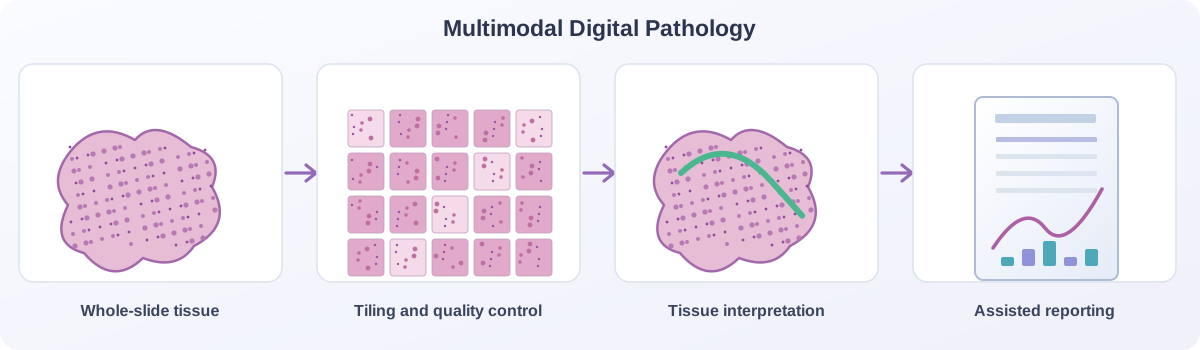
This research brings together the major stages of building reproducible AI systems for histopathology, from whole-slide image (WSI) preparation and quality control to model development, region-level annotation, and downstream analysis.
Research program: Multimodal Analysis in Digital Pathology
Period: July 2024 to Present
Funder: National Institutes of Health (NIH), USA
Role: Postdoctoral Researcher
Whole-slide image workflow
- Developed end-to-end WSI pipelines for tissue classification, tumor-region segmentation, and multimodal pathology analysis.
- Built scalable preprocessing procedures for artifact filtering, tissue/tile extraction, and image quality checks.
- Applied pathology foundation models and image-text representations for downstream analysis and reporting workflows.
- Used QuPath for tumor-region annotation and quality assurance of reference labels.
- Curated large-scale tissue-tile datasets to support robust experimentation and reproducible model evaluation.
Related clinical laboratory automation
In related collaborative work, developed AI-assisted workflows for serum protein electrophoresis (SPE) and immunofixation electrophoresis (IFE), including:
- Detecting and quantifying candidate monoclonal (M-protein) peaks in electrophoretic profiles.
- Detecting abnormal monoclonal bands in electrophoresis gel images.
- Integrating quantitative and image-derived signals into report-oriented analysis workflows.
This clinical chemistry work is described separately from the NIH-funded histopathology pipeline; the funding listed above is not intended as a claim about its specific funding source.
Research methods and capabilities
The broader research program also covers robust WSI preprocessing, information-aware image selection, tissue-level dataset development, foundation-model representation learning, and patient-level predictive modeling.
For manuscript titles, results, and publication status, see Publications.