Lightweight Disabled Parking Sign Detection
Efficient small-object recognition using an enhanced YOLOv5 detection architecture
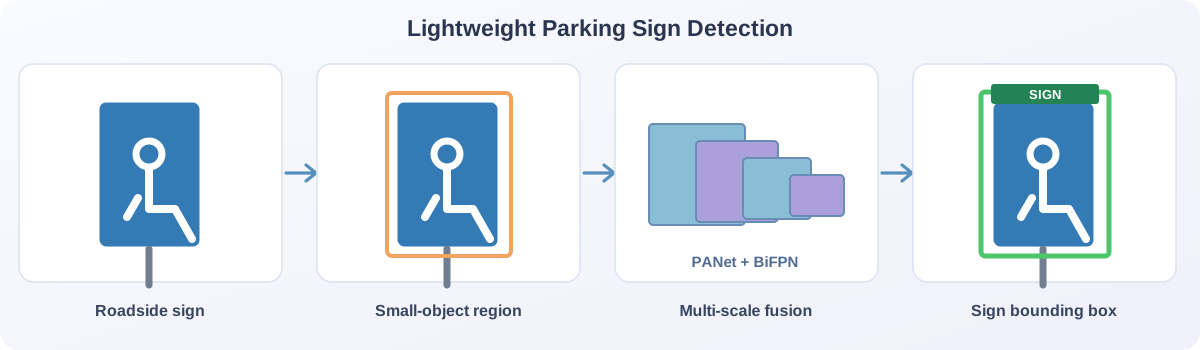
This project studied how to recognize small disabled-parking signs in complex imagery while reducing the computational cost of the detection model. It explored feature fusion and architectural simplification for practical object detection.
Research period: July 2021 to December 2021
Funder: Small and Medium Business Technology Information Promotion Agency, South Korea
Role: Project Developer and Lead
Research objectives
- Improve small-object detection in YOLOv5 for disabled-parking sign recognition.
- Develop a lightweight fused-architecture variant (LF-YOLOv5) that balances detection effectiveness and computational efficiency.
Contributions
- Studied limitations of small-object localization in conventional object detectors.
- Integrated Path Aggregation Network (PANet) and weighted Bidirectional Feature Pyramid Network (BiFPN) components for multi-scale feature fusion.
- Explored reducing feature-map computation to lower model complexity.
- Conducted experiments using 1,025 original disabled-sign images, augmented to approximately 15,000 training and evaluation samples.
Methods
YOLOv5, object detection, PANet, weighted BiFPN, feature fusion, data augmentation, efficient deep learning.
Note: The figures above describe the project scope and dataset preparation; no independent benchmark score is claimed here.